How to Write a Rental Listing That Attracts Quality Tenants in Edmonton and Calgary
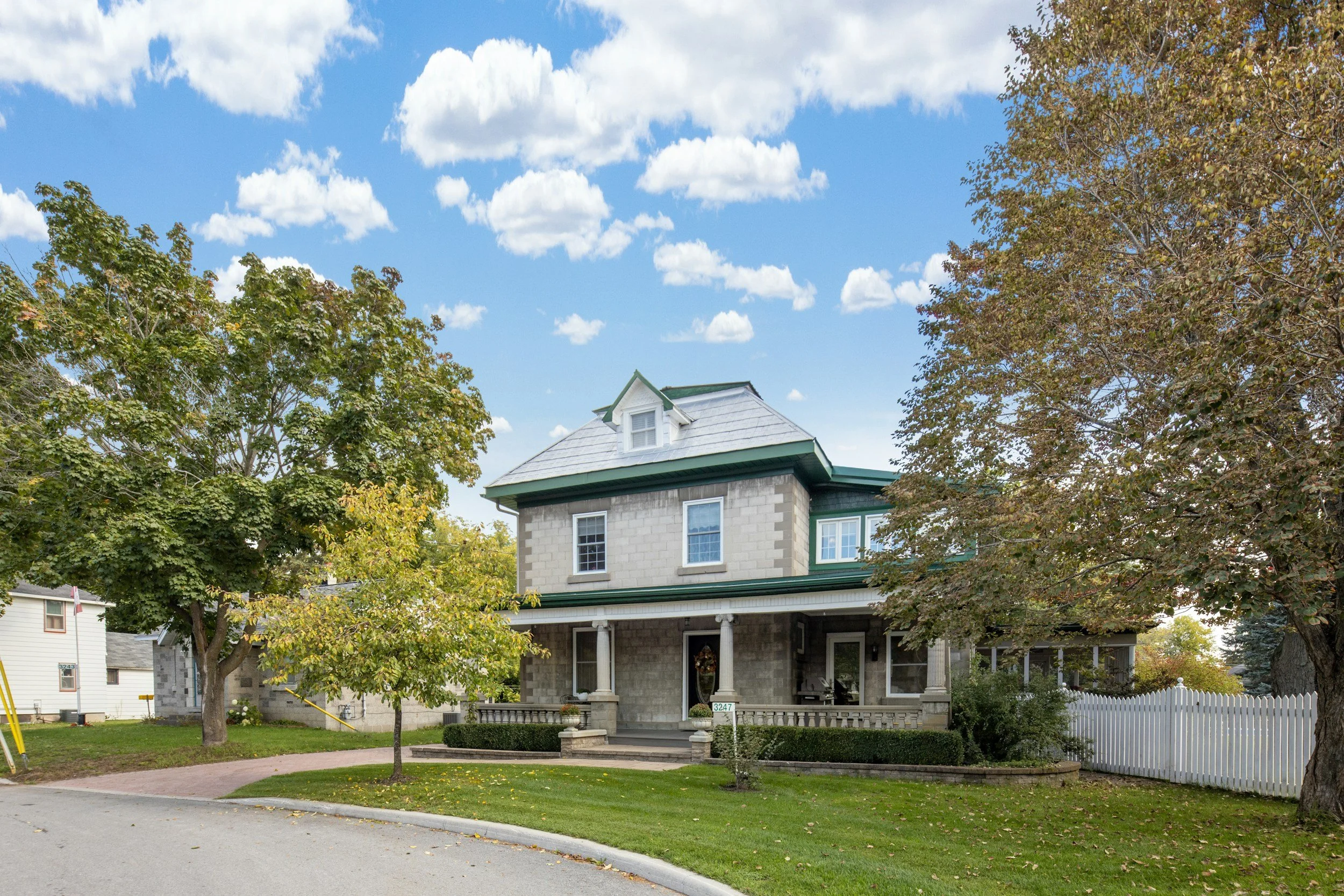
A great rental listing does two things at once: it attracts the tenants you want, and it filters out the ones you don't. A poorly written listing, or no listing at all beyond a few photos and a price, results in a flood of unqualified inquiries, longer vacancies, and more frustration. Getting the listing right is one of the highest-leverage things you can do as a landlord before you ever screen a single application.
Here is how to write a rental listing that consistently attracts quality applicants in Edmonton and Calgary's rental market.
Why Your Listing Is Your First Screening Tool
Most landlords think of tenant screening as something that happens after the applications come in. But screening actually begins with the listing itself. The language you use, the information you include, and the expectations you set attract certain types of applicants while discouraging others.
A listing that describes a clean, well-maintained property with clear expectations around income requirements and reference checks signals to responsible tenants that you are a professional landlord. It also signals to less qualified applicants that they may not pass your process, which reduces the time you spend on applications that were never going to work out.
Definition: A rental listing is a public advertisement for a vacant rental unit that includes property details, rent, eligibility criteria, and contact instructions. In a competitive market like Edmonton or Calgary, a well-structured listing functions as both a marketing tool and the first stage of tenant screening.
Start With the Basics: What Every Listing Must Include
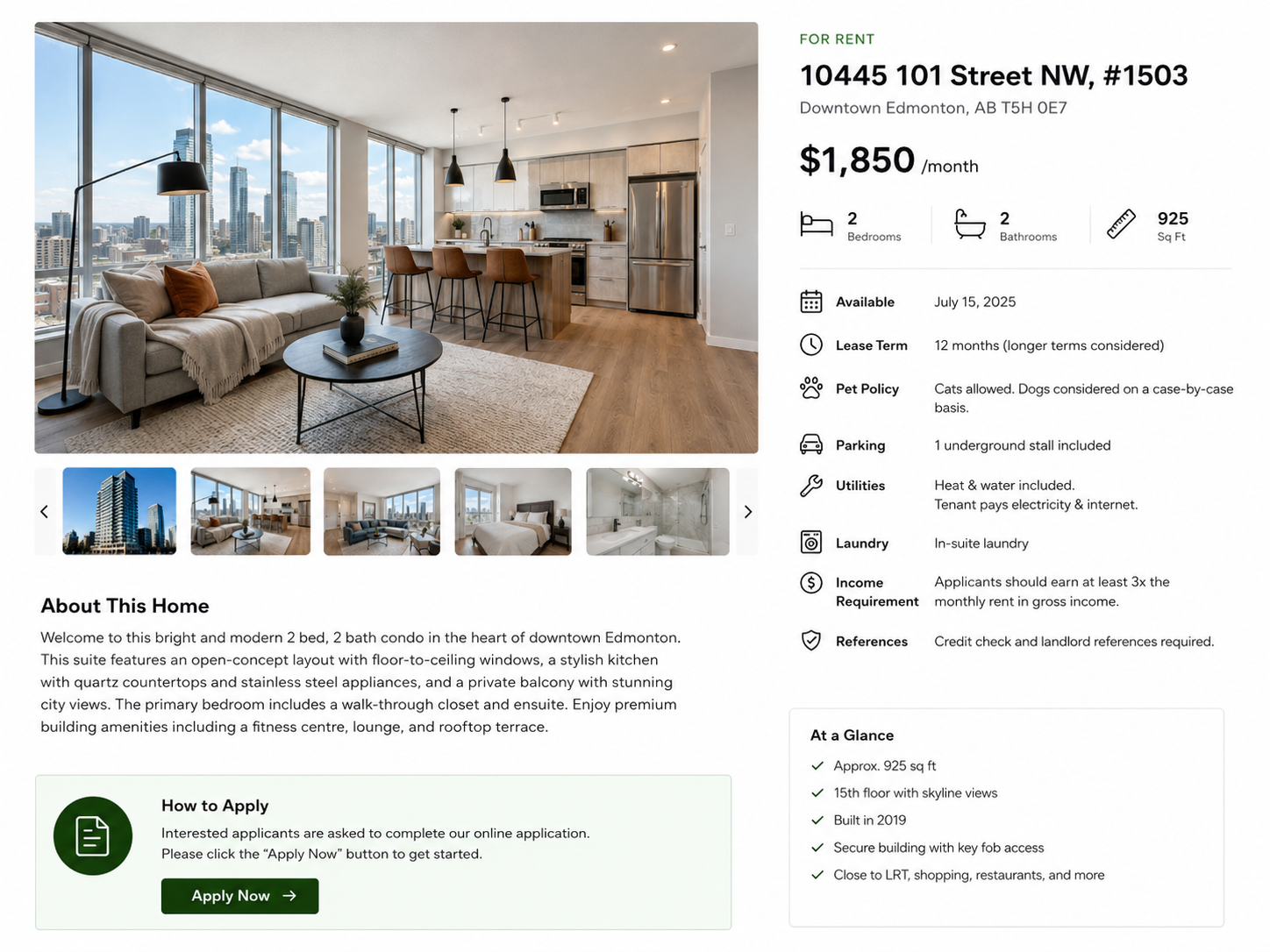
Before thinking about copywriting, make sure your listing contains all the information a qualified tenant needs to self-qualify. Missing information forces applicants to email or call with basic questions before they even decide to apply. This wastes your time and adds friction for serious applicants who may move on to the next listing.
Every rental listing should include:
The full address or at minimum the neighbourhood and cross-streets
Monthly rent (not "contact for pricing" — serious tenants skip vague listings)
Number of bedrooms and bathrooms
Approximate square footage
Available date
Lease term (fixed one-year, month-to-month, or both)
Pet policy (yes, no, or considered on a case-by-case basis)
Parking availability (included, street only, or additional cost)
Utilities included or not included
Laundry (in-suite, shared, or none)
Income and reference requirements
How to apply (link or email)
Including your income requirement upfront is particularly important. The standard in Edmonton and Calgary is that applicants should earn at least three times the monthly rent in gross income. Stating this clearly saves you and unqualified applicants significant time.
Writing the Property Description: What Actually Works
The description is where most landlords either undersell their property or oversell it in ways that attract the wrong people. Here is a framework that works.
Lead With the Best Feature
Do not start your description with "Welcome to this lovely home." Start with whatever makes this property stand out. Is it a renovated kitchen? A private backyard? Two blocks from the LRT in Calgary's Beltline? A basement suite in a quiet southeast Edmonton neighbourhood with great schools? Lead with that.
Your first two sentences should tell a qualified tenant immediately whether this property is worth reading further. If those sentences are generic, most serious applicants skim past.
Describe the Space Accurately
Describe the layout clearly and honestly. Mention storage, natural light, parking, and any recent updates (new appliances, fresh paint, updated bathroom). Be specific. "Updated kitchen" means nothing. "Kitchen renovated in 2023 with new stainless appliances, quartz countertops, and updated cabinetry" tells a story.
Avoid inflating the description. Exaggerated listings generate viewings from people who feel deceived when they arrive, which wastes everyone's time and damages your credibility. A tenant who feels misled will either not apply or, worse, will not be happy once they move in.
Describe the Neighbourhood
Tenants are choosing a neighbourhood as much as a unit. Mention nearby transit stops, grocery stores, parks, schools (if family-relevant), and commute proximity to major employment centres. Edmonton and Calgary both have distinct neighbourhood identities, and helping tenants understand where they would be living is genuinely useful.
For example, if you are renting in Garneau in Edmonton, mention the University of Alberta proximity and the walkability to Whyte Avenue. If you are in Bridgeland in Calgary, mention the pedestrian access to downtown and proximity to the CTrain. These details attract the right tenant profile for each neighbourhood.
State Your Requirements and Expectations Clearly
This is the part most landlords skip, and it is one of the most valuable things you can add. A short paragraph at the end of your description that says something like:
"We are looking for tenants with stable employment, verifiable income of at least 3x the monthly rent, positive references from previous landlords, and a clean credit history. We conduct a full application review including credit check, income verification, and landlord references."
This filters your applicant pool without a single phone call. Responsible applicants read this and apply with confidence. Marginal applicants often self-select out. For a deeper look at what to check once applications arrive, see our guide on How Property Managers in Alberta Find Better Tenants Faster
Photos: The Single Biggest Factor in Listing Performance
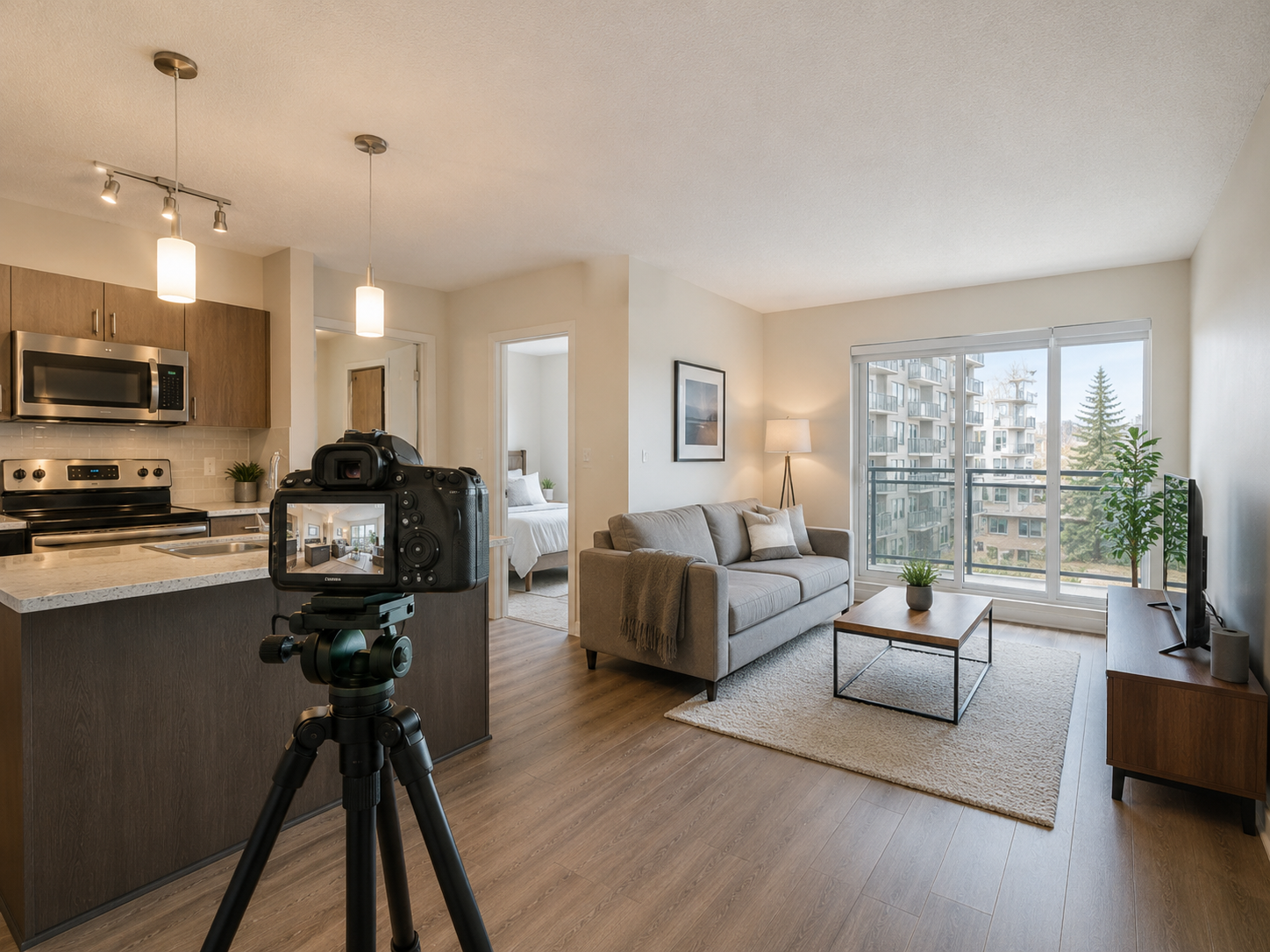
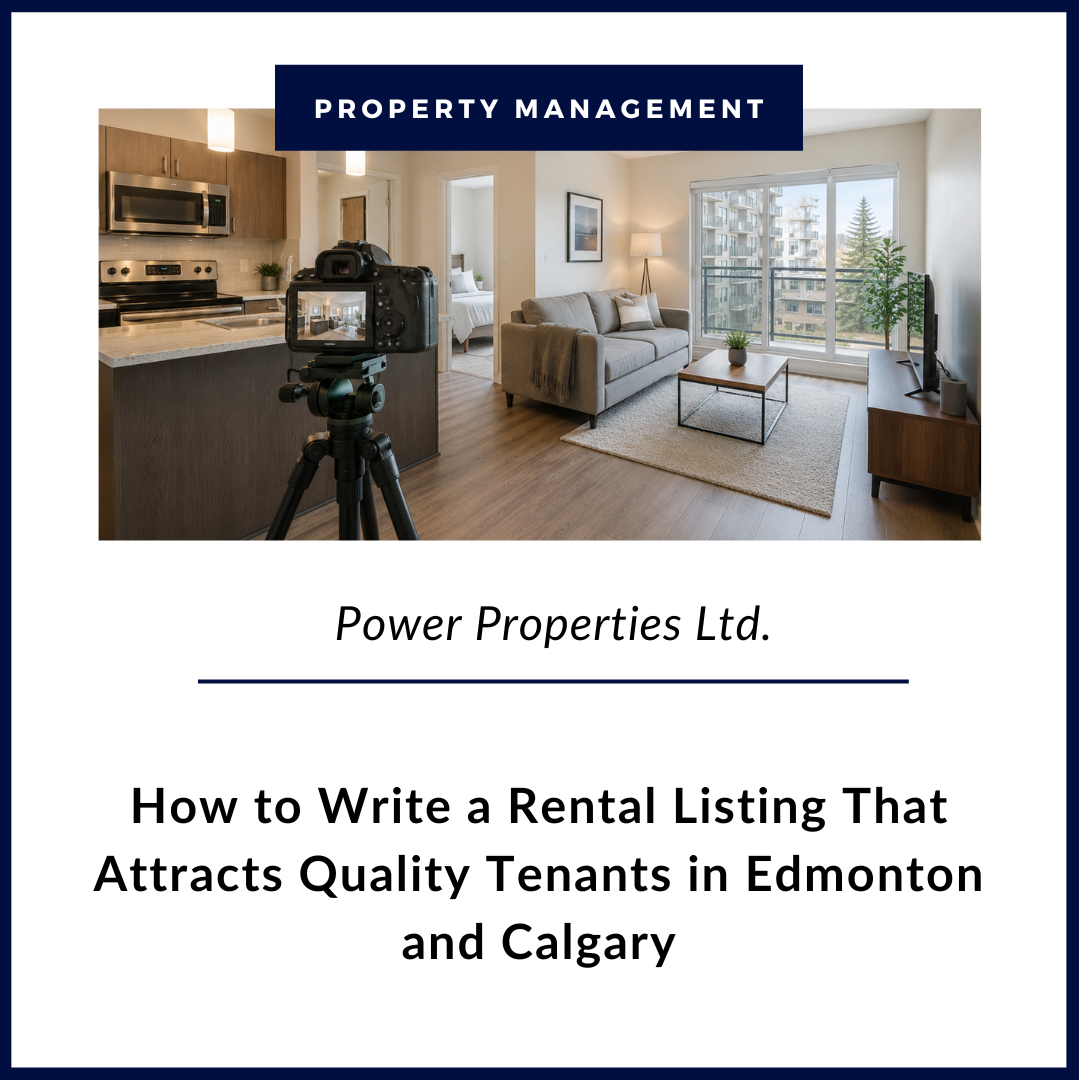
Nothing determines how many qualified inquiries a listing receives more than photo quality. This is not an area to cut corners.
Here is what professional property managers know that most self-managing landlords don't: listings with professional photography rent faster and attract higher-quality applicants. In Edmonton and Calgary's competitive rental market, a well-photographed listing stands out immediately against the sea of dark, cluttered, smartphone photos that dominate platforms like Rentfaster and Rentals.ca.
You do not have to hire a professional photographer, though it is worth considering. At minimum, follow these guidelines:
Photograph every room, including bathrooms and storage
Clean and declutter the property before shooting, every surface should be clear
Shoot during daylight hours with natural light coming through windows
Use landscape orientation on your camera, not portrait
Shoot from corners to capture as much of the room as possible
Include at least one exterior photo showing the front of the property
Include a photo of the parking area, laundry facilities, and any outdoor space
If the property is currently occupied, coordinate with your tenant to photograph a clean unit before they move out. For vacant units, a basic staging of furniture helps viewers understand the scale and feel of each room.
Where to List: The Right Platforms for Edmonton and Calgary
A listing that no one sees generates no applicants. In Alberta's rental market, here are the platforms worth using:
| Platform | Best For | Cost | Reach in AB |
|---|---|---|---|
| Rentfaster | All property types, broad reach | Paid | Very High |
| Rentals.ca | Apartments, condos, houses | Free basic / Paid premium | High |
| PadMapper | Young professionals, map-based search | Free, syndicated from other sites | Medium–High |
| Facebook Marketplace | Neighbourhood-level reach, local tenants | Free | High |
| Zumper | Tech-savvy renters, quick applications | Free basic | Medium |
| Your own network | Referrals from current tenants, community groups | Free | Variable |
Post on at least two or three platforms simultaneously. Different tenant demographics use different platforms. A 28-year-old professional moving to Calgary may find your listing on Rentfaster, while a family relocating to Edmonton may find it through a Facebook community group.
Pricing Your Listing: The Most Important Single Decision
Setting the wrong rent price is more costly than any listing copy mistake you could make. Price too high and your property sits vacant while comparable units get rented. Price too low and you attract higher volumes of applications, miss income you could have had, and sometimes signal that something is wrong with the unit.
Search active listings on Rentfaster and Rentals.ca for comparable units in the same neighbourhood. Look at properties with similar bedrooms, bathrooms, square footage, and amenities. Track what they are asking and, if possible, how long they stay listed. If a comparable unit has been listed for three weeks without renting, it is likely priced too high.
What to Say in Inquiries and Showing Confirmations
How you respond to inquiries is an extension of your listing. Slow, vague responses lose good tenants to faster landlords. Here is what works:
Respond to every inquiry within a few hours during business hours. Acknowledge their message, confirm the unit is still available, and ask them to answer two or three basic screening questions before scheduling a viewing. For example: "What is your approximate household income? Do you have references from previous landlords? When are you looking to move?"
This pre-qualifies applicants before you invest time in a showing. Someone who cannot answer these basic questions is not ready to apply. A qualified tenant will answer them readily.
For the showing itself, arrive on time, present the property in its best state (lights on, clean, aired out), and have application forms ready so interested tenants can take them with them.
Key Takeaways
Lead your description with your property's strongest feature, not generic language
Include all essential details upfront so qualified tenants can self-qualify before contacting you
State your income and reference requirements clearly in the listing itself
Use quality photos, in good light with decluttered rooms, taken from corner-to-corner
Post on at least two to three platforms to reach different tenant demographics
Price based on comparable active listings, not what you want or what you charged last year
Pre-qualify applicants in the first inquiry response before investing time in showings
Frequently Asked Questions
-
Long enough to answer every question a qualified tenant would have before deciding to apply. For a typical Edmonton or Calgary single-family home or condo, that is usually 150 to 300 words in the description, plus all the structured details (beds, baths, rent, utilities, pets). Avoid padding with filler sentences, and never cut information out for the sake of brevity.
-
Always list the price. Serious tenants skip listings with no price because they assume it either means the landlord doesn't know what they're asking or it will be too expensive. Withholding the price adds friction and filters out good applicants, not bad ones.
-
Yes, you can state income requirements in your listing. Requiring tenants to demonstrate they can afford the rent is a legitimate and non-discriminatory screening criterion. The standard is typically three times the monthly rent in gross income. What you cannot do is discriminate based on source of income (such as refusing tenants on social assistance) in some municipalities.
-
The busiest rental seasons in both Edmonton and Calgary are May through August, with another smaller surge in January. Listing in late April or early May gives you the best pool of applicants. Listings posted in November or February face fewer active applicants.
-
At least 10 to 15 photos covering every room, the exterior, parking, laundry, and outdoor space. More is better. Tenants who cannot get a clear picture of the unit from photos often skip it rather than asking for more.
-
Yes, if you can. A short walk-through video posted to YouTube or included directly in the listing gives long-distance applicants (particularly newcomers to Edmonton and Calgary) the context they need to apply with confidence. It also reduces the number of viewings with people who decide on arrival that it's not for them.
-
If a tenant breaches their agreement, the situation must be handled in strict compliance with the Alberta Residential Tenancies Act (RTA). The standard procedure involves issuing a formal 14-day Eviction Notice for non-payment or substantial breach. If the tenant fails to comply or vacate, the next step is applying to the Residential Tenancy Dispute Resolution Service (RTDRS) or the Alberta Court of Justice for an official order of possession.
Want Better Tenants Without the Listing Hassle?
Writing and managing a rental listing well takes time, skill, and follow-through. Property managers in Edmonton and Calgary do this every day, with professional photography, optimized listing copy, multi-platform distribution, and pre-screening calls handled before a single showing is booked.
Power Properties® has been placing quality tenants in Edmonton and Calgary rental properties for over 45 years. Our leasing process is designed to minimize vacancy duration and maximize applicant quality, so your property is never sitting empty with a mediocre listing. Visit www.powerproperties.net to learn more about our full-service property management and tenant placement services.
About Power Properties Ltd.
Founded in 1980, Power Properties has been providing hassle-free property management services to property owners, property investors and non-residents with homes in Calgary, Edmonton, Lethbridge and Medicine Hat for over 45 years. Our full-service property management includes everything from move in to move out, so you don’t have to worry about the day-to-day operations of your rental property. With a team of licensed professionals, years of experience, and award-winning service, you can rest assured that your property is in good hands.